
Artificial intelligence is changing how software understands information, makes decisions, and performs tasks.
Blockchain, on the other hand, provides programmable environments where transactions and rules can be executed transparently without relying entirely on centralized intermediaries.
When these two technologies come together, a new possibility emerges:
AI agents that can independently interact with blockchain networks.
Instead of simply providing recommendations, AI-powered agents can potentially monitor markets, analyze on-chain activity, interact with smart contracts, and execute predefined actions based on changing conditions.
This could introduce a new generation of autonomous applications across the Web3 ecosystem.
What Are AI Agents?
AI agents are software systems designed to perceive information, reason about a task, and take actions toward a specific goal.
Unlike traditional automation, an AI agent can evaluate changing conditions and determine which action may be appropriate.
When connected to blockchain infrastructure, these agents can interact directly with decentralized applications and smart contracts.
For example, an agent could monitor a DeFi portfolio, analyze market conditions, and execute a predefined strategy when certain conditions are met.
The blockchain provides the execution environment.
AI provides the decision-making layer.
Why It Matters
1️⃣ Autonomous Applications
Web3 applications can perform more complex tasks without requiring users to manually execute every transaction.
2️⃣ Real-Time Decision Making
AI agents can continuously analyze market and on-chain data and respond to changing conditions.
3️⃣ Simplified Web3 Interaction
Users can describe a goal while an AI agent determines the steps required to accomplish it.
4️⃣ Automated Financial Strategies
Agents can monitor liquidity, prices, portfolio conditions, and other signals to execute predefined strategies.
How It Works
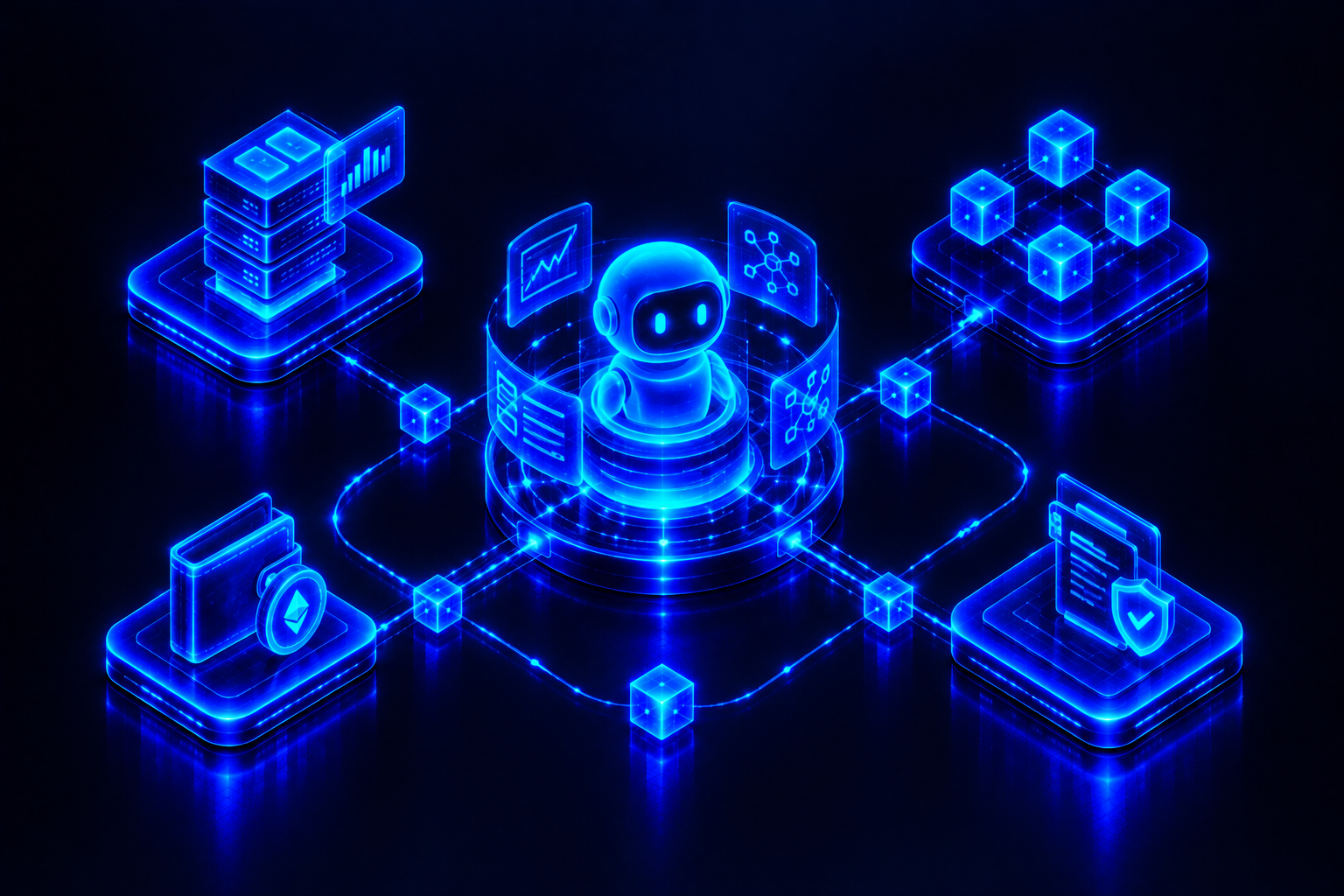
A typical blockchain AI agent can include several layers:
🔹 Data Layer
The agent collects information from blockchain networks, applications, market feeds, and other data sources.
🔹 Intelligence Layer
AI models analyze the available information and determine what action may best satisfy the agent’s objective.
🔹 Wallet & Permission Layer
The agent receives carefully defined permissions that determine which blockchain actions it is allowed to perform.
🔹 Smart Contract Layer
Approved actions are executed through blockchain transactions and smart contracts.
This creates a continuous loop:
Observe → Analyze → Decide → Execute → Monitor
Use Cases
DeFi Automation
AI agents can monitor market conditions and manage predefined financial strategies across decentralized protocols.
Portfolio Management
Agents can track assets, evaluate portfolio conditions, and suggest or execute rebalancing strategies according to user-defined rules.
On-Chain Monitoring
AI systems can analyze large volumes of blockchain activity and identify unusual patterns, emerging risks, or potentially suspicious behavior.
DAO Operations
Agents could help monitor governance proposals, summarize discussions, analyze voting activity, or perform predefined administrative tasks.
Web3 Customer Experiences
Instead of interacting with complex blockchain interfaces, users could communicate with an intelligent agent that translates their goals into blockchain operations.
The Importance of Permissions
Giving an AI agent direct access to blockchain assets introduces an important security question:
What is the agent actually allowed to do?
Autonomous systems should not necessarily have unlimited wallet access.
Developers can instead design permission systems with restrictions such as:
- Transaction limits
- Approved contracts
- Spending limits
- Time-based permissions
- Human approval for high-risk operations
- Emergency shutdown mechanisms
This creates a balance between autonomy and user control.
AI Agents and Smart Contracts
AI models and smart contracts have fundamentally different strengths.
AI systems are flexible and capable of handling complex, uncertain information.
Smart contracts are deterministic and designed to execute predefined rules.
This creates a powerful division of responsibilities.
AI decides.
Smart contracts enforce.
An AI agent might determine that a particular action should be taken, while a smart contract ensures that the action follows predefined rules and permissions.
This combination can make autonomous Web3 applications more practical while keeping critical execution logic verifiable.
Challenges
AI-powered blockchain agents also introduce new risks:
- Model errors
- Incorrect decisions
- Malicious inputs
- Prompt manipulation
- Private-key security
- Smart contract vulnerabilities
- Unpredictable behavior
Unlike traditional smart contracts, AI agents may operate in environments where decisions are probabilistic rather than completely deterministic.
For high-value applications, strong permission systems, transaction simulation, monitoring, and human oversight can therefore remain essential.
The Future of Autonomous Web3
The next generation of decentralized applications may not require users to manually manage every transaction.
Instead, users could define goals and constraints while autonomous agents handle the underlying complexity.
Imagine telling an application:
“Maintain this portfolio according to my risk preferences.”
The agent could monitor the relevant data, evaluate available options, and interact with blockchain protocols according to the permissions granted by the user.
This does not mean removing humans from the process.
It means moving humans from transaction operators to goal setters and decision makers.
The Convergence of AI and Blockchain
AI can provide intelligence, automation, and adaptability.
Blockchain can provide programmable execution, transparency, and verifiable ownership.
Together, they create the foundation for applications that can not only process information but also act on-chain.
As AI agents become more capable and blockchain infrastructure becomes easier to interact with, autonomous systems could become an important part of the Web3 ecosystem.
The future is autonomous:
Web3 applications may no longer wait for users to execute every action—they may understand the goal, evaluate the environment, and act within the rules defined by their users.

Leave a Reply