
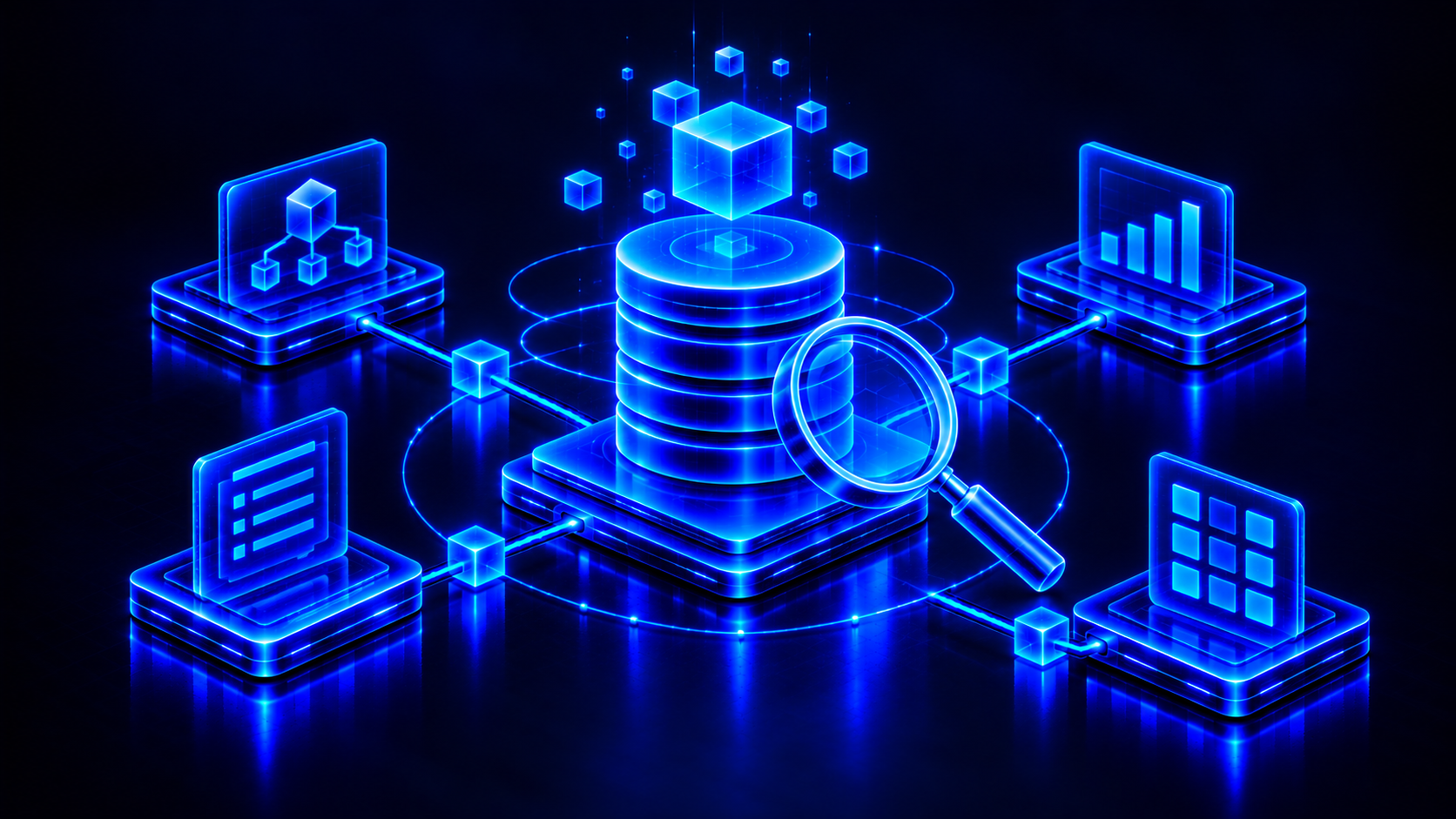
Blockchains generate enormous amounts of data every day. Every transaction, smart contract interaction, token transfer, and protocol event becomes part of an increasingly large and complex digital record.
Although blockchain networks provide transparent and publicly accessible data, retrieving useful information from them is not always straightforward. Applications often need to search across thousands of blocks, identify specific events, track wallet activity, or calculate historical metrics. Performing these operations directly against blockchain nodes can be slow, resource-intensive, and difficult to scale.
Blockchain indexing addresses this challenge by organizing raw on-chain information into structured, searchable datasets.
By transforming blockchain activity into accessible data, indexing infrastructure enables developers to build analytics platforms, portfolio trackers, decentralized applications, and monitoring systems that can respond efficiently to complex queries.
As the Web3 ecosystem expands, blockchain indexing is becoming an essential part of the infrastructure connecting decentralized networks with the applications built on top of them.
What Is Blockchain Indexing?
Blockchain indexing is the process of collecting, processing, organizing, and storing blockchain data in a structure that makes it easier to search and retrieve.
A blockchain node maintains information about blocks, transactions, and network state. However, its primary responsibility is to participate in or support the operation and verification of the network, not necessarily to provide optimized search capabilities for every application.
For example, a decentralized application may need to answer questions such as:
- Which tokens has a particular wallet received?
- How many transactions did a smart contract process last month?
- What was the historical trading volume of a decentralized exchange?
- Which addresses interacted with a specific protocol?
- How has a token’s holder distribution changed over time?
Answering these questions may require processing large amounts of blockchain data.
An indexing system extracts relevant information, organizes it according to predefined structures, and makes it available through query interfaces such as APIs or GraphQL endpoints.
Instead of repeatedly scanning raw blockchain data, applications can retrieve the information they need from an optimized data layer.
How Blockchain Indexing Works
Although implementations differ, most blockchain indexing systems follow a similar processing pipeline.
1. Collecting Blockchain Data
The first stage involves retrieving data from one or more blockchain networks.
Indexers connect to blockchain nodes and monitor newly produced blocks, transactions, receipts, and smart contract events.
Depending on the application, they may also retrieve historical blockchain data to build a complete dataset from earlier blocks.
Reliable data collection is important because missing blocks or events can create incomplete records.
2. Extracting Relevant Information
Raw blockchain data contains many different types of information.
An indexing system identifies the fields and events relevant to its intended use case.
For example, a token analytics platform may extract:
- Transaction hashes and block numbers.
- Sender and recipient addresses.
- Token contract addresses.
- Transferred amounts.
- Transaction timestamps.
- Smart contract event parameters.
This stage converts general blockchain records into information that can be processed more efficiently.
3. Decoding Smart Contract Events
Smart contracts frequently emit events when important operations occur.
These events provide structured information about activities such as token transfers, swaps, liquidity changes, and governance decisions.
An indexer can use a contract’s Application Binary Interface (ABI) to decode event data into readable fields.
For example, a decentralized exchange may emit an event whenever a token swap takes place. The indexer can decode the event and extract the traded assets, amounts, and relevant transaction information.
This makes it easier for applications to analyze protocol activity without manually interpreting low-level transaction data.
4. Transforming and Organizing Data
After extraction, the indexer processes the information and organizes it into a suitable data model.
This may involve filtering irrelevant records, converting data formats, calculating derived values, and linking related entities.
For example, individual token transfer events can be organized into wallet transaction histories, while swap events can be aggregated into trading volume statistics.
The resulting data is stored in databases designed to support efficient retrieval.
5. Making Data Available Through APIs
Once the information has been indexed, applications can access it through query interfaces.
These interfaces may use REST APIs, GraphQL, or other data-access mechanisms.
A developer can request a wallet’s transaction history, retrieve protocol statistics, or filter events by block range without independently processing the entire blockchain.
6. Keeping Data Synchronized
Blockchain indexing is an ongoing process.
New blocks are continuously produced, and the indexer must process them to keep its datasets current.
A robust system also needs to handle temporary node failures, network interruptions, duplicate events, and blockchain reorganizations.
If a previously observed block is replaced during a chain reorganization, the indexer may need to reverse affected records and process the canonical chain again.
This synchronization process is essential for maintaining data accuracy.
Why Blockchain Indexing Matters
Improving Application Performance
Applications that query raw blockchain data directly may experience slow response times, especially when retrieving historical information or performing complex searches.
Indexing reduces this burden by preparing data in advance and storing it in structures optimized for querying.
This allows applications to deliver faster and more responsive user experiences.
Simplifying Web3 Development
Without indexing infrastructure, developers may need to build custom data-processing pipelines for every application.
They would have to retrieve blocks, decode events, manage historical records, and maintain databases independently.
Indexing services provide reusable infrastructure that reduces this complexity and allows development teams to focus more on application logic.
Supporting Advanced Blockchain Analytics
Raw blockchain data becomes significantly more useful when it is organized and connected.
Indexing makes it possible to analyze wallet behavior, protocol performance, token distribution, transaction trends, and market activity.
These capabilities are essential for analytics platforms and research tools that need to process large volumes of on-chain information.
Enabling Real-Time Monitoring
Many blockchain applications need to respond to events as they occur.
An indexing system can monitor contract activity and make newly processed information available to applications.
For example, a monitoring dashboard can detect large token transfers, unusual contract interactions, or changes in protocol activity.
This supports real-time notifications, automated workflows, and risk-monitoring systems.
Key Use Cases of Blockchain Indexing
DeFi Analytics Platforms
Decentralized finance protocols generate large amounts of information through swaps, deposits, withdrawals, lending operations, and liquidations.
Indexing systems collect these events and organize them into meaningful metrics.
Analytics platforms can use this information to display:
- Trading volume and liquidity.
- Total Value Locked (TVL).
- Lending and borrowing activity.
- Historical protocol performance.
- Wallet-level transaction activity.
Without efficient indexing, building comprehensive DeFi dashboards would require significant data-processing infrastructure.
Wallet and Portfolio Applications
Crypto wallets often need to display a user’s assets and transaction history across multiple blockchain networks.
Indexing systems can retrieve token transfers, contract interactions, and historical activity associated with a wallet address.
This allows portfolio applications to provide organized transaction histories, asset summaries, and activity timelines.
NFT Marketplaces
NFT marketplaces need access to information about token ownership, transfers, listings, sales, and collection activity.
An indexer can monitor NFT contract events and organize them into searchable records.
Applications can then retrieve collection statistics, ownership histories, recent sales, and marketplace activity without scanning the entire blockchain for every request.
Blockchain Explorers
Blockchain explorers allow users to search for addresses, transactions, blocks, and smart contracts.
These applications rely heavily on indexing because users expect search results to appear quickly and consistently.
An indexing system makes it possible to retrieve information using transaction hashes, wallet addresses, block numbers, and other identifiers.
Compliance and Risk Monitoring
Blockchain transparency creates opportunities for monitoring financial activity and identifying suspicious patterns.
Indexing infrastructure can organize wallet interactions, transaction flows, and contract events into datasets that support compliance analysis.
Risk-monitoring platforms can use these datasets to identify unusual behavior, trace asset movements, and investigate potentially suspicious transactions.
However, indexing alone does not establish whether an activity is illegal or malicious. Additional analytical methods and contextual investigation are required.
DAO Governance Analytics
Decentralized autonomous organizations generate governance-related data through proposals, voting, delegation, and execution.
Indexing systems can collect these events and organize them into governance dashboards.
This makes it easier to analyze voter participation, proposal outcomes, voting power distribution, and historical governance activity.
Blockchain Indexing vs. Traditional Database Systems
Blockchain indexing and traditional database systems share several technical characteristics, but they serve different purposes.
Traditional databases are generally designed around application-specific data models and controlled write operations.
Blockchain indexing systems, on the other hand, process information generated by decentralized networks. They must account for block ordering, transaction finality, smart contract events, and possible chain reorganizations.
A traditional database may allow an application to update or delete records directly. An indexing system must preserve the relationship between its records and the underlying blockchain history.
Another important distinction is data verification.
An indexed record is a representation of blockchain information, not an independent replacement for the blockchain itself. Applications that require strong verification guarantees may need to validate important information against the underlying network or trusted cryptographic proofs.
In practice, many Web3 applications combine blockchain nodes, indexing services, and traditional databases to create a complete data infrastructure.
Popular Approaches to Blockchain Indexing
Event-Based Indexing
Event-based indexing focuses on smart contract events emitted during transaction execution.
Developers define which contracts and events should be monitored, and the indexing system extracts relevant information whenever those events appear.
This approach is particularly useful for DeFi protocols, NFT platforms, and applications with well-defined smart contract interfaces.
Full-Block Indexing
Full-block indexing processes broader blockchain information, including blocks, transactions, and execution-related data.
It can support applications that need more comprehensive historical analysis or information that is not fully represented by selected contract events.
However, processing and maintaining this information can require substantial storage and computational resources.
Subgraph-Based Indexing
Subgraph-based indexing allows developers to define how blockchain data should be collected, transformed, and exposed to applications.
Developers specify relevant contracts, event handlers, and data structures.
The indexing infrastructure then processes blockchain activity according to those definitions and exposes the resulting data through query interfaces.
This approach can make blockchain data access more standardized and reusable.
Multi-Chain Indexing
As Web3 expands across multiple blockchain networks, applications increasingly need to combine data from different ecosystems.
Multi-chain indexing collects and organizes information from several networks within a unified data infrastructure.
This can support cross-chain portfolio tracking, analytics dashboards, and applications that operate across multiple execution environments.
However, different networks may use different data models, event formats, and finality mechanisms, making normalization an important part of the process.
Challenges and Limitations
Despite its benefits, blockchain indexing introduces several technical challenges.
Data Consistency
Indexers must ensure that their stored information accurately represents the canonical blockchain history.
Network interruptions, duplicated events, processing errors, and chain reorganizations can create inconsistencies.
Reliable systems need mechanisms for detecting errors, reprocessing affected data, and recovering from incomplete synchronization.
Scalability and Storage Requirements
Large blockchain networks generate substantial amounts of historical information.
As transaction volume increases, indexing systems must process more data and maintain larger datasets.
Efficient database design, partitioning, caching, and optimized query execution become increasingly important.
Blockchain Reorganizations and Finality
Some blockchain networks may temporarily change their canonical chain when a competing block sequence replaces an earlier one.
An indexer must recognize these changes and update its records accordingly.
The challenge becomes more complex when applications operate across networks with different finality models.
Data Accuracy and Interpretation
An indexed dataset may be technically correct while still being misleading if its information is interpreted incorrectly.
For example, calculating token balances may require accounting for minting, burning, transfers, and protocol-specific behavior.
Similarly, calculating DeFi metrics such as TVL requires careful consideration of asset prices, duplicated collateral, and protocol accounting rules.
Infrastructure Costs
Maintaining blockchain nodes, historical datasets, processing pipelines, and query infrastructure can be expensive.
Applications must balance data freshness, query performance, storage requirements, and operational costs.
Centralization and Data Availability
Many applications depend on third-party indexing providers.
If a provider becomes unavailable, changes its service policies, or returns incomplete information, dependent applications may experience disruptions.
Decentralized indexing approaches aim to reduce reliance on individual providers, although they introduce additional coordination and incentive-design challenges.
The Future of Blockchain Indexing
As blockchain ecosystems become more complex, indexing infrastructure will continue to evolve.
One important direction is decentralized indexing. Instead of relying on a single provider, indexing tasks can be distributed across independent participants who process blockchain data and make queryable information available.
Another development is the growth of unified multi-chain data platforms. As users interact with multiple networks, applications will increasingly need consistent access to information across different blockchain environments.
Artificial intelligence may also improve blockchain data analysis. AI-powered systems could help identify unusual transaction patterns, classify wallet activity, detect anomalies, and generate insights from large on-chain datasets.
However, these systems will still depend on accurate source data and transparent analytical methods.
Real-time indexing is another important area of development. Applications involving trading, monitoring, gaming, and financial automation require data pipelines that can process new blockchain events with minimal delay.
Finally, improvements in cryptographic verification may allow applications to retrieve indexed information while also obtaining stronger evidence that the information corresponds to the underlying blockchain state.
The long-term objective is to make blockchain data more accessible without compromising transparency, reliability, or decentralization.
Conclusion
Blockchain indexing is a critical infrastructure layer that transforms raw blockchain activity into structured and searchable information.
By organizing transactions, smart contract events, and historical records, indexing systems make it possible to build responsive decentralized applications, advanced analytics platforms, portfolio tools, and real-time monitoring services.
As Web3 expands across multiple networks and application environments, the demand for efficient and reliable data access will continue to grow.
However, successful indexing requires more than collecting blockchain records. Systems must maintain data consistency, handle reorganizations, scale efficiently, and preserve a clear connection between indexed information and the underlying blockchain.
Ultimately, blockchain indexing helps turn the transparency of decentralized networks into practical information that developers, businesses, and users can understand and act upon. It will remain an essential foundation for the next generation of data-driven Web3 applications.

Leave a Reply