
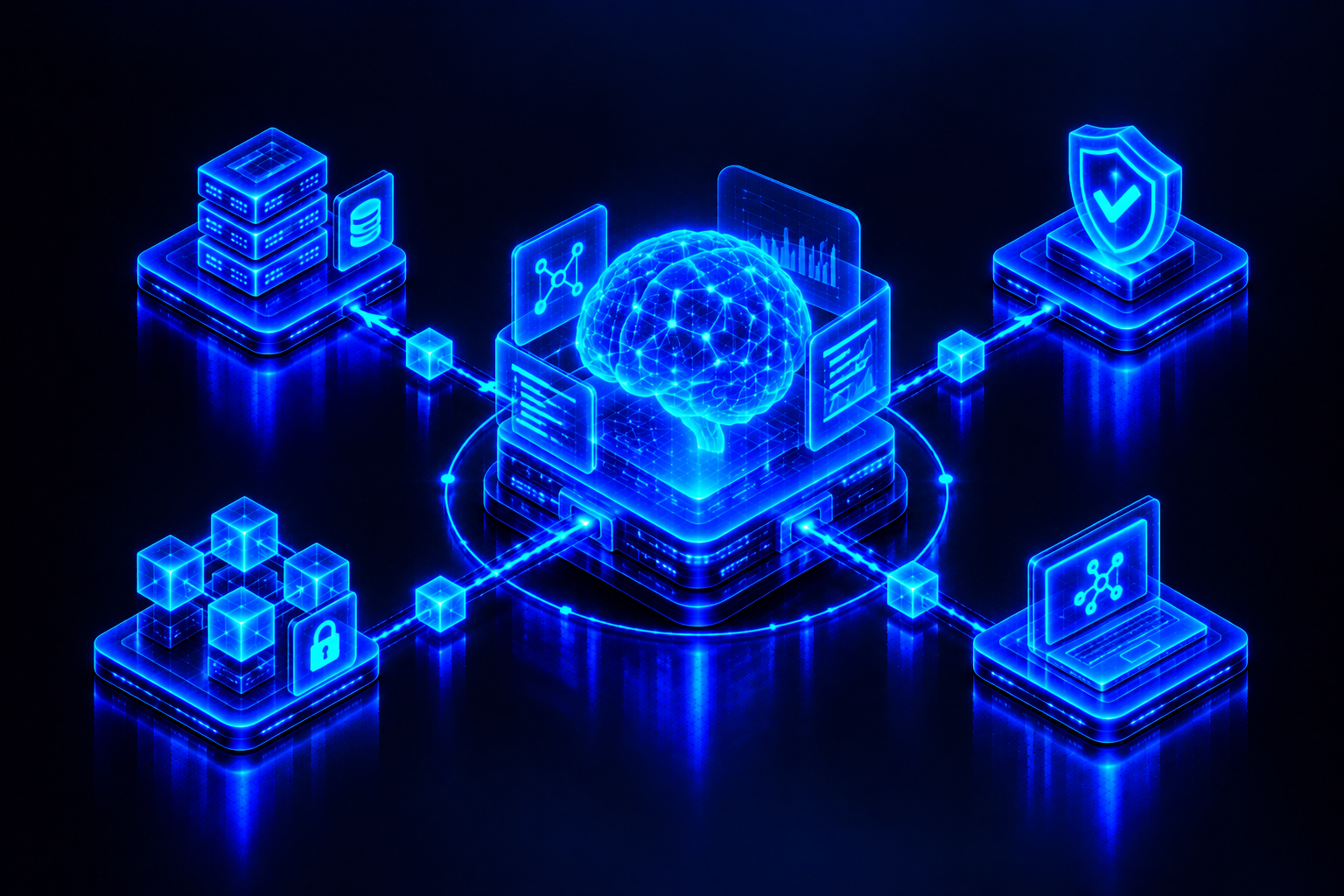
Artificial intelligence is becoming increasingly powerful, influencing everything from financial decisions and automated trading to identity verification and decentralized applications.
However, as AI systems become more autonomous, an important question emerges:
How can we trust the results produced by an AI system when we cannot easily verify how those results were generated?
Traditional AI applications often rely on centralized infrastructure, proprietary models, and processes that users cannot independently inspect.
Blockchain introduces a different approach through transparency, cryptographic verification, and programmable trust.
By combining these capabilities with emerging verification technologies, developers are exploring ways to make AI outputs more accountable and verifiable.
This concept is known as Verifiable AI.
What Is Verifiable AI?
Verifiable AI refers to techniques that help users or applications independently verify specific properties of an AI system, its computations, or its outputs.
Rather than simply trusting a model’s response, a system can provide additional evidence about how a result was produced or whether particular requirements were satisfied.
Depending on the architecture, this evidence may include cryptographic proofs, execution attestations, reproducible computations, or verifiable records of model activity.
Blockchain can complement these mechanisms by recording verification results, managing permissions, and establishing transparent rules for how AI-driven actions are authorized.
The goal is not necessarily to reveal every detail of an AI model.
Instead, it is to make important claims about its behavior easier to verify.
Why Verifiable AI Matters
1. Greater Accountability
Applications can record important AI decisions and their associated verification evidence, making it easier to audit how automated systems behave.
2. Reduced Dependence on Blind Trust
Users can evaluate specific guarantees instead of relying entirely on a provider’s reputation or promises.
3. Privacy-Preserving Verification
Cryptographic techniques can sometimes demonstrate that a computation satisfies particular conditions without exposing all the underlying data.
4. Safer Automation
AI systems that interact with smart contracts can be required to satisfy predefined verification and authorization rules before actions are executed.
How It Works
A verifiable AI architecture may contain several components:
🔹 AI Model
The model analyzes information, generates predictions, or produces a recommendation.
🔹 Verification Layer
Specialized mechanisms evaluate a specific claim about the computation, execution environment, or output.
🔹 Cryptographic Evidence
Where supported, the system generates proofs or attestations that can be checked independently.
🔹 Blockchain Infrastructure
A smart contract or decentralized application verifies relevant evidence, records commitments, or enforces execution rules.
🔹 Application Layer
The application uses the verified result according to its security requirements.
The exact architecture depends on what needs to be verified. A cryptographic proof of a computation, for example, provides a different guarantee from an attestation that identifies the hardware and software used to run a model.
Key Technologies Behind Verifiable AI
Zero-Knowledge Proofs
Zero-Knowledge Proofs can demonstrate that certain computations or statements satisfy specified conditions without revealing all the underlying information.
In AI, proof systems may be designed to verify particular computations, although proving large neural network operations can still be computationally expensive.
Trusted Execution Environments
Trusted Execution Environments isolate workloads within protected hardware environments.
Attestation mechanisms can provide evidence about the software or environment involved in a computation. However, this approach depends on hardware security and does not eliminate every possible attack.
On-Chain Verification
Smart contracts can verify supported cryptographic proofs and enforce rules based on their results.
This allows decentralized applications to incorporate verification into automated workflows without necessarily executing the entire AI workload on-chain.
Reproducible Computation
In certain systems, developers can make model execution more reproducible by specifying the model version, input data, software dependencies, and execution parameters.
Reproducibility can help with auditing, although it does not automatically prove that a model’s conclusions are correct.
Use Cases
DeFi Risk Analysis
AI systems can analyze market conditions, liquidity, and transaction patterns. Verification mechanisms can help applications enforce specific constraints before an AI-generated recommendation triggers a financial operation.
Blockchain Security
AI can identify potentially suspicious transaction patterns, while verification and audit mechanisms help security teams investigate alerts and understand the evidence behind them.
Decentralized AI Marketplaces
Model providers could publish information about their models, versions, and supported verification guarantees. Smart contracts could manage access, payments, and service conditions.
AI-Powered Smart Contracts
An AI system could propose an action while a smart contract checks predefined conditions before permitting execution.
For example, a contract could enforce spending limits or require additional authorization for high-risk operations.
Data Privacy
Privacy-preserving verification techniques can help applications demonstrate that certain rules were followed without publishing all the sensitive data involved.
Verifiable AI vs. Trusting an AI Provider
Traditional AI services often ask users to trust the provider’s infrastructure, implementation, and operational practices.
Verifiable AI attempts to replace some of that trust with independently checkable evidence.
The distinction is important.
A model’s answer is not automatically correct just because it comes with a cryptographic proof.
A proof may establish that a particular computation was performed correctly, but it does not necessarily prove that the input data was accurate, the model was unbiased, or the conclusion was meaningful.
Reliable systems must therefore define exactly what is being verified and what remains outside the verification process.
Challenges
Despite its potential, Verifiable AI faces several technical and practical challenges:
- High computational costs for proving complex AI workloads
- Difficulty verifying large neural networks efficiently
- Privacy risks involving inputs and outputs
- Model updates and version management
- Hardware and software trust assumptions
- Verification of data quality and authenticity
- Integration with existing blockchain infrastructure
Another major challenge is balancing transparency with intellectual property protection. AI developers may want to demonstrate certain guarantees without revealing proprietary models or sensitive training information.
No single verification technique solves every one of these problems.
The Future of Verifiable Intelligence
As AI agents begin interacting with financial systems, decentralized applications, and digital infrastructure, verifying their behavior will become increasingly important.
Blockchain can provide coordination and enforceable rules, while cryptographic proofs, secure execution environments, and auditing mechanisms can provide different forms of evidence about AI computations.
Together, these technologies could support applications where users do not need to trust every component equally.
Instead, they can verify specific guarantees, limit the actions an AI system is allowed to perform, and preserve an auditable record of important decisions.
The objective is not to make AI infallible. It is to make its operation more transparent, accountable, and secure.
Conclusion
Verifiable AI represents an important step toward building more trustworthy intelligent systems.
By combining artificial intelligence with cryptographic verification and blockchain-based coordination, developers can create applications that offer stronger guarantees about selected computations and automated actions.
The technology still faces significant challenges, particularly around computational efficiency, privacy, and the limits of what verification can actually prove.
Nevertheless, as AI becomes more deeply integrated into Web3, the ability to verify important claims about intelligent systems could become a fundamental part of decentralized infrastructure.
The future of AI will not depend only on how intelligent models become, but also on how confidently we can verify what they do.


Leave a Reply