
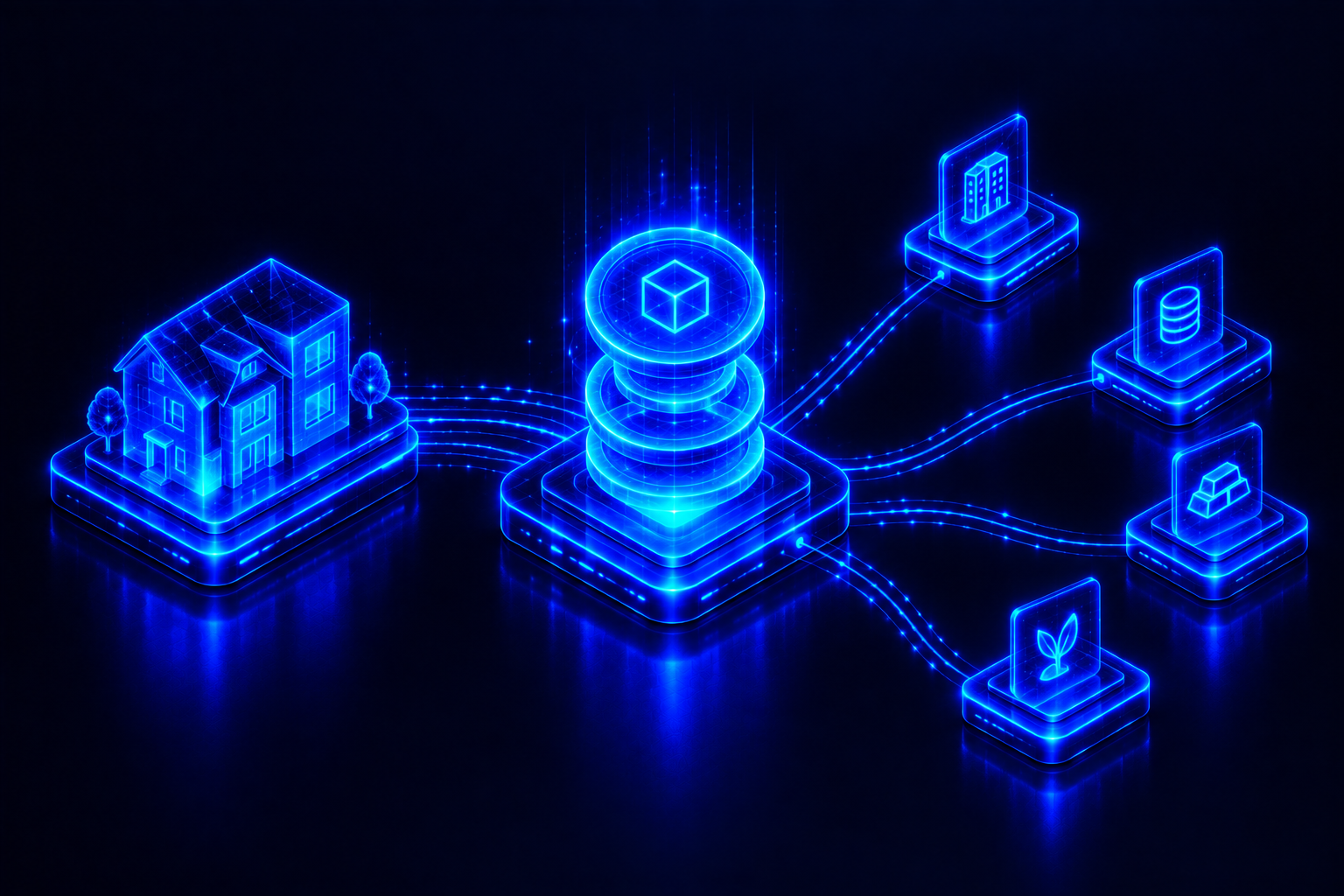
Blockchain technology is increasingly moving beyond cryptocurrencies and purely digital assets.
One of the most significant developments is the tokenization of Real-World Assets (RWAs)—the process of representing physical or traditional financial assets as digital tokens on a blockchain.
From real estate and government bonds to commodities and private credit, tokenization creates a bridge between traditional financial markets and decentralized infrastructure.
This could fundamentally change how ownership, investment, and financial assets are issued and exchanged.
What Is Asset Tokenization?
Asset tokenization is the process of creating a blockchain-based representation of an asset or an ownership claim associated with it.
Instead of relying entirely on traditional databases and intermediaries, ownership records can be represented through programmable digital tokens.
These tokens can potentially be transferred, divided into smaller units, and integrated directly with blockchain-based applications.
For example, a high-value asset could be represented by multiple digital tokens, allowing ownership or economic exposure to be distributed among multiple participants.
Why It Matters
1️⃣ Greater Accessibility
Tokenization can lower barriers to accessing certain asset classes by enabling fractional ownership.
2️⃣ Faster Settlement
Blockchain infrastructure can reduce the time required to transfer and settle transactions.
3️⃣ Programmable Ownership
Smart contracts can automate rules related to transfers, distributions, and asset management.
4️⃣ Global Connectivity
Tokenized assets can potentially interact with decentralized financial infrastructure across different markets.
How It Works
A typical RWA tokenization system includes several important layers:
🔹 Asset
A real-world asset such as real estate, securities, commodities, or private credit.
🔹 Legal Framework
The ownership rights represented by the token must be connected to enforceable legal structures.
🔹 Tokenization Layer
The asset or its economic rights are represented through blockchain-based tokens.
🔹 Verification & Custody
Trusted systems verify the underlying asset and maintain accurate records of ownership and collateral.
🔹 Smart Contracts
Blockchain-based programs manage transfers, distributions, and other predefined functions.
Together, these layers connect physical and traditional financial assets with blockchain infrastructure.
Use Cases
Real Estate
Properties can be divided into smaller digital ownership units, potentially making investment more accessible.
Government Bonds
Traditional financial instruments can be represented and settled using blockchain infrastructure.
Private Credit
Loans and credit instruments can be issued, tracked, and managed through programmable systems.
Commodities
Assets such as precious metals can be represented digitally while maintaining links to underlying reserves.
Challenges
Despite its potential, RWA tokenization faces several major challenges:
- Legal recognition of tokenized ownership
- Asset custody and verification
- Regulatory compliance
- Liquidity limitations
- Reliable off-chain data
- Interoperability between financial systems
Blockchain technology can provide the infrastructure, but successful tokenization also requires strong legal, financial, and operational frameworks.
The Future of Tokenized Markets
The tokenization of real-world assets could become one of the most important bridges between traditional finance and Web3.
As regulatory frameworks mature and blockchain infrastructure becomes more scalable, an increasing number of financial and physical assets could move onto programmable digital networks.
This would not necessarily replace traditional financial markets.
Instead, it could transform their underlying infrastructure—making ownership more transparent, settlement more efficient, and financial assets easier to integrate with digital applications.
The future is tokenized:
the next evolution of blockchain may not be about creating entirely new assets—it may be about bringing the assets we already use into a more programmable financial system.
Leave a Reply