
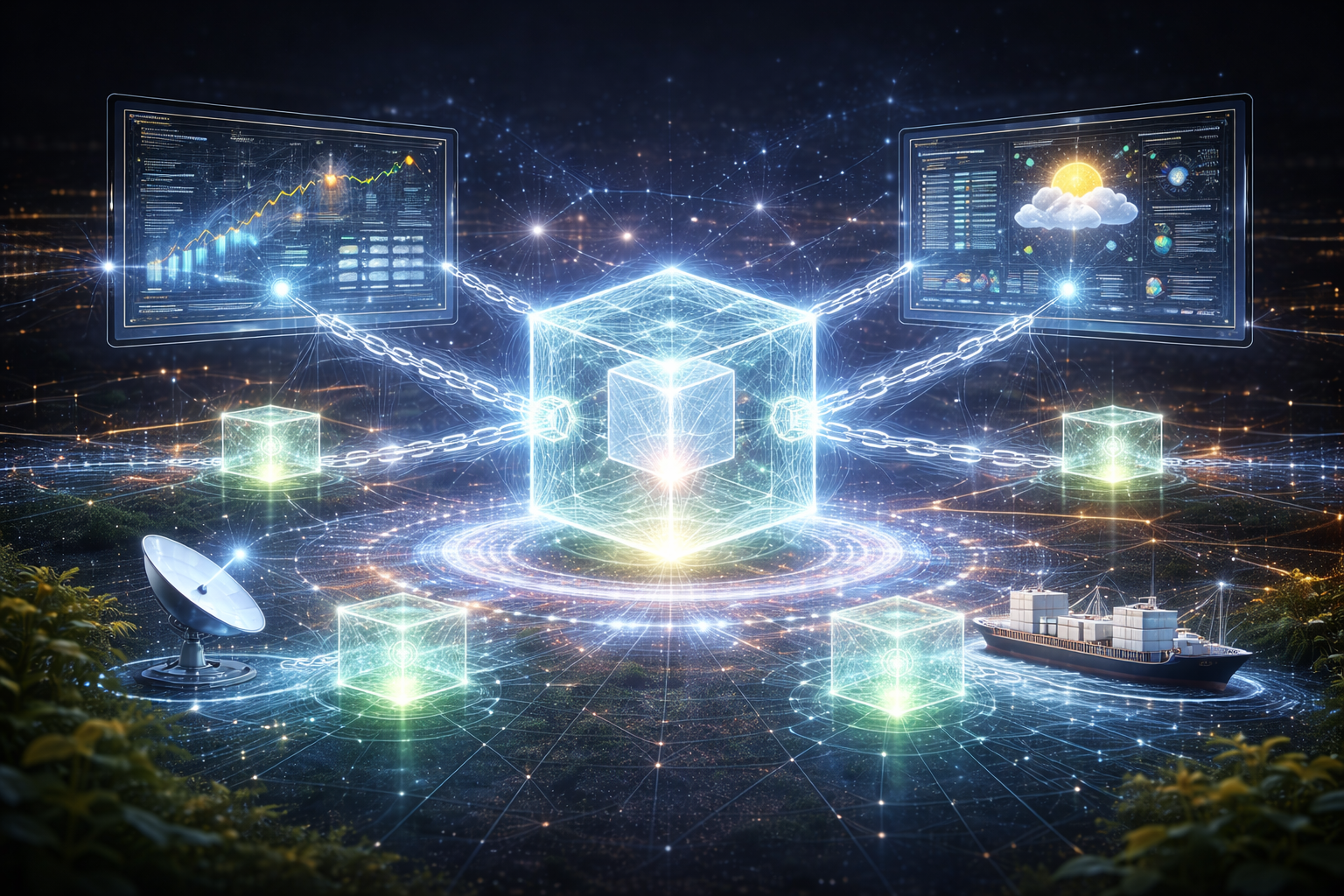
Smart contracts are one of the most powerful innovations in blockchain technology. They enable automated, trustless execution of agreements without intermediaries. However, smart contracts operate within isolated blockchain environments and cannot access external data on their own.
This limitation creates a critical challenge: how can smart contracts interact with real-world information?
This is where blockchain oracles come into play — acting as bridges between on-chain logic and off-chain data.
What Are Blockchain Oracles?
Blockchain oracles are services that provide external data to smart contracts, enabling them to execute based on real-world events.
Since blockchains are deterministic systems, they require reliable inputs to trigger actions. Oracles deliver this data securely, allowing smart contracts to function beyond purely on-chain conditions.
Oracles can provide:
- Market prices
- Weather data
- Sports results
- IoT sensor data
- API-based information
Without oracles, smart contracts would be limited to internal blockchain data only.
Why Oracles Matter
Expanding Smart Contract Use Cases
Oracles unlock a wide range of real-world applications, from financial derivatives to insurance systems.
Enabling DeFi Infrastructure
Decentralized finance platforms rely heavily on accurate price feeds provided by oracles.
Automating Real-World Agreements
Contracts can execute automatically when specific external conditions are met.
Bridging Web2 and Web3
Oracles connect traditional systems and data sources with decentralized applications.
Types of Oracles
Software Oracles
Fetch data from online sources such as APIs, databases, and websites.
Hardware Oracles
Collect data from physical devices like sensors and IoT systems.
Inbound Oracles
Provide external data to smart contracts.
Outbound Oracles
Send blockchain data to external systems.
Decentralized Oracles
Use multiple data sources to reduce reliance on a single provider and improve reliability.
Challenges and Risks
Despite their importance, oracles introduce new considerations.
Data Reliability
If the oracle provides incorrect data, the smart contract will execute incorrectly.
Centralization Risk
Single-source oracles can become points of failure.
Security Vulnerabilities
Oracles can be targeted by attackers attempting to manipulate data inputs.
Latency Issues
Delays in data delivery can affect time-sensitive applications.
The Future of Oracle Networks
As blockchain adoption grows, oracle networks are becoming more advanced and decentralized. New models focus on improving data accuracy, reducing trust assumptions, and enhancing security.
In the future, oracles will play a foundational role in enabling complex, real-world blockchain applications — from automated insurance claims to global financial systems.
Smart contracts are powerful, but without reliable data, they remain limited. Oracles unlock their true potential by connecting blockchain to the real world.
Leave a Reply