
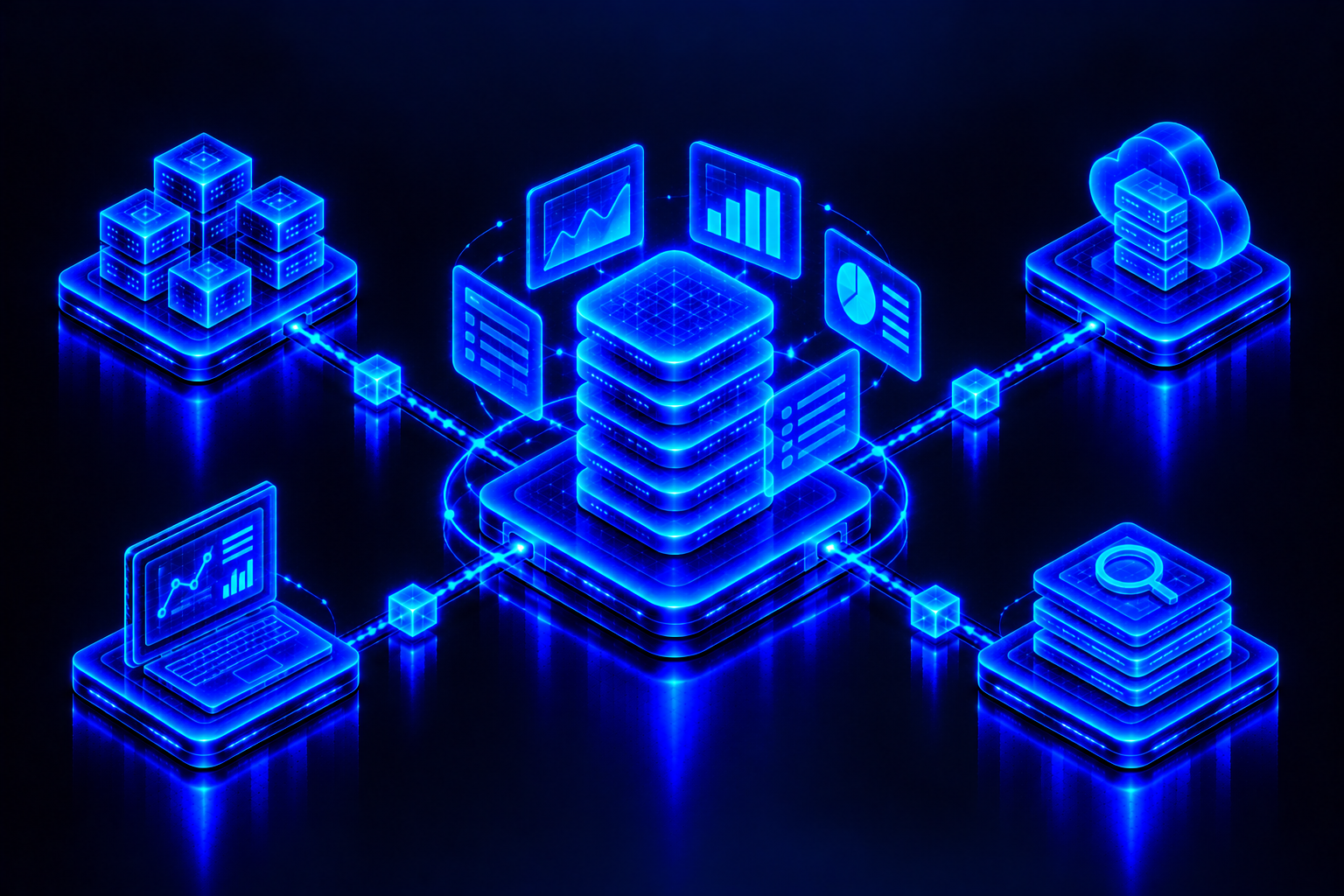
Blockchain networks generate enormous amounts of data every day. Every transaction, smart contract interaction, token transfer, and decentralized application activity contributes to a continuously growing public record. While this transparency is one of blockchain’s greatest strengths, accessing and interpreting that information efficiently remains a significant technical challenge.
Blockchain indexing helps solve this problem by organizing raw on-chain data into structured, searchable formats. Instead of requiring applications to scan entire blockchain histories, indexing systems make it possible to retrieve relevant information quickly and build more responsive user experiences.
As decentralized finance, Web3 analytics, and blockchain-based services continue to expand, indexing is becoming an essential part of the infrastructure that connects blockchain data with real-world applications.
What Is Blockchain Indexing?
Blockchain indexing is the process of collecting, processing, organizing, and making blockchain data available for efficient querying.
A blockchain stores information in blocks linked together through cryptographic mechanisms. Although this structure provides transparency and verifiability, it is not inherently optimized for complex searches. Finding every transaction associated with a wallet, tracking token balances over time, or analyzing activity across thousands of smart contracts can require significant processing.
Indexing systems address this limitation by transforming blockchain records into structured datasets that applications can search using databases, APIs, and query languages.
For example, a blockchain explorer can display the transaction history of a wallet within seconds because an indexing system has already organized the relevant information. Similarly, a DeFi dashboard can present historical trading volumes, liquidity movements, and token transfers without repeatedly scanning the entire blockchain.
Indexing does not replace the blockchain itself. It creates a more accessible layer for interacting with the data stored on it.
How Blockchain Indexing Works
Although implementations vary, most blockchain indexing systems follow several fundamental steps.
1. Collecting Blockchain Data
The process begins by connecting to a blockchain node or another reliable data source. The indexing system monitors newly produced blocks and retrieves relevant information, including transactions, events, contract logs, and block metadata.
Depending on the application, it may also process historical blocks to build a comprehensive dataset.
2. Decoding and Processing Events
Raw blockchain data is not always immediately useful to an application. Smart contract events often contain encoded information that must be interpreted using contract interfaces and application-specific logic.
An indexer decodes these events, identifies relevant entities, and transforms the information into a structured representation.
For instance, a token transfer event can be processed into a record containing the sender, recipient, transferred amount, token contract, transaction hash, and timestamp.
3. Organizing Data for Queries
After processing, the information is stored in a format designed for efficient retrieval. Depending on the use case, this may involve relational databases, search indexes, specialized blockchain databases, or other data storage technologies.
Developers can then query specific information without having to reconstruct it from the blockchain’s entire history.
4. Updating and Maintaining the Index
Blockchain indexing is an ongoing process. As new blocks are added, the indexer processes new events and updates its records.
Reliable systems must also handle temporary network failures, duplicated events, changes in data sources, and blockchain reorganizations. When a chain reorganizes, previously observed blocks may no longer belong to the canonical chain, requiring affected records to be corrected.
This is particularly important for applications that depend on accurate balances, transaction histories, or financial analytics.
Why Blockchain Indexing Matters
Faster and More Responsive Applications
Without indexing, many blockchain queries can be computationally expensive or difficult to perform directly. Indexing reduces the amount of work required to retrieve information, helping applications deliver faster results.
This improves user experiences across wallets, blockchain explorers, NFT platforms, trading interfaces, and portfolio trackers.
Better Access to Historical Data
Blockchain applications frequently need more than the latest state of a network. They may need to analyze activity over weeks, months, or years.
Indexing makes historical information easier to retrieve, enabling developers to build transaction histories, performance charts, financial reports, and behavioral analytics.
More Powerful Data Analytics
Organized blockchain data supports deeper analysis of network activity. Businesses can examine transaction patterns, measure protocol usage, evaluate liquidity movements, and identify changes in user behavior.
For platforms such as ChainWiser, reliable access to structured blockchain data can support market intelligence, transaction monitoring, and data-driven decision-making.
Reduced Infrastructure Complexity
Building a data-intensive Web3 application directly on raw blockchain records can require significant engineering effort. Indexing services abstract much of this complexity, allowing developers to focus on application logic rather than repeatedly implementing data retrieval pipelines.
Key Use Cases of Blockchain Indexing
Decentralized Finance Analytics
DeFi protocols produce continuous streams of data related to swaps, liquidity pools, lending positions, liquidations, and yield generation.
Indexing enables analytics platforms to combine these events into meaningful metrics. Developers can build dashboards that track total value locked, historical trading volume, liquidity changes, and protocol activity.
Accurate indexing is especially important when these metrics influence investment decisions or risk assessments.
Wallets and Blockchain Explorers
Wallet applications need to display transaction histories, token transfers, NFT ownership, and other account-related information.
Indexing makes these features more practical by allowing applications to retrieve activity associated with a wallet without scanning every block from the beginning of the network.
Blockchain explorers use similar techniques to present searchable records of transactions, addresses, blocks, and smart contracts.
NFT Marketplaces and Digital Asset Platforms
NFT platforms rely on data about token ownership, transfers, listings, sales, and collection activity.
An indexing layer can organize this information into searchable collections and provide the foundation for ownership histories, marketplace analytics, and asset discovery.
Because NFT metadata may be stored outside the blockchain, reliable systems must also distinguish between on-chain records and externally hosted content.
Compliance and Transaction Monitoring
Financial institutions and blockchain analytics providers need to examine transaction flows, wallet relationships, and historical activity.
Indexing helps consolidate relevant events into datasets that support monitoring and investigation. Combined with analytical models and risk-scoring systems, this infrastructure can help identify suspicious patterns and support compliance workflows.
However, indexing alone does not establish whether a transaction is illegal or suspicious. That requires additional context, analytical methods, and appropriate review.
Cross-Chain Data Analytics
As blockchain ecosystems become increasingly interconnected, applications often need to analyze activity across multiple networks.
Indexing systems can normalize data from different chains into a more consistent format, making it easier to compare transactions, monitor assets, and investigate activity across supported networks.
Cross-chain indexing must account for differences in transaction models, finality rules, event formats, and asset representations.
Challenges and Limitations
Despite its benefits, blockchain indexing introduces several technical and operational challenges.
Data Accuracy and Consistency
An index is a derived representation of blockchain data. If an indexing pipeline misses events, processes them incorrectly, or fails to handle reorganizations, the resulting dataset may become inconsistent with the underlying chain.
Reliable implementations need validation mechanisms, recovery procedures, and reconciliation with authoritative blockchain records.
Scalability and Storage Costs
Popular networks can generate substantial volumes of transaction and event data. Indexing this information requires computing resources, storage capacity, and efficient query infrastructure.
As networks grow, developers must balance query speed, data completeness, retention policies, and operating costs.
Centralization Risks
Many applications depend on third-party indexing providers. While these services can simplify development, they may introduce availability dependencies, rate limits, or a single point of failure.
Projects can reduce these risks through multiple data sources, self-hosted indexers, caching strategies, and independent verification where appropriate.
Data Freshness and Finality
A transaction that appears in a newly produced block may not yet have reached the network’s desired level of finality. An indexing system must communicate the difference between newly observed activity and sufficiently confirmed data.
This distinction matters for exchanges, financial applications, and other systems where acting on unconfirmed information can create operational or financial risk.
Complex Queries Across Different Networks
Each blockchain may expose data differently. Differences in execution environments, event structures, and finality mechanisms complicate efforts to create a unified indexing layer.
Standardized data models can help, but they must preserve important chain-specific details rather than hiding meaningful differences.
The Role of Indexing in the Future of Web3
Blockchain indexing is evolving from a supporting utility into a core component of Web3 data infrastructure.
As decentralized applications become more sophisticated, demand will grow for lower-latency queries, richer historical datasets, and easier access to information across multiple networks. Developers will increasingly combine indexing with streaming pipelines, analytics engines, and specialized query services.
Another important direction is verifiable data processing. Applications that rely on indexed information may need stronger ways to establish that the data was collected and transformed correctly. Cryptographic proofs, reproducible processing, and independent validation can help improve confidence in indexing outputs.
Artificial intelligence may also increase demand for structured blockchain datasets. AI-driven analytics systems need consistent, well-organized information to identify trends, detect unusual activity, and generate useful insights. High-quality indexing can provide the data foundation for these applications, although the quality of the underlying information and analytical models remains essential.
At the same time, developers will need to preserve transparency about data sources, indexing delays, and known limitations.
Conclusion
Blockchain indexing bridges the gap between transparent blockchain records and the applications that depend on them. By transforming raw on-chain activity into structured, searchable information, indexing enables faster interfaces, richer analytics, and more practical access to historical data.
From DeFi dashboards and NFT marketplaces to compliance platforms and cross-chain analytics, indexing supports many of the services that make Web3 useful beyond basic transactions.
As blockchain adoption grows, efficient and reliable access to on-chain information will become increasingly important. Projects that invest in accurate, scalable, and resilient indexing infrastructure will be better positioned to turn blockchain data into meaningful insights and dependable digital experiences.
Leave a Reply