
Identity verification has become an essential part of the digital world. Whether opening a financial account, accessing online services, or proving eligibility, users are frequently asked to share personal information.
Unfortunately, this often means exposing far more data than necessary.
What if you could prove who you are—or prove a specific fact about yourself—without revealing the underlying information?
This is the vision behind Zero-Knowledge Identity (ZK Identity).
By combining decentralized identity with zero-knowledge cryptography, ZK Identity enables secure verification while preserving user privacy.
What Is Zero-Knowledge Identity?
Zero-Knowledge Identity is a privacy-focused identity model that allows individuals to prove specific claims without disclosing the actual data behind them.
Instead of sharing an entire document or identity record, users generate cryptographic proofs that verify only what is required.
For example, someone could prove that they are over 18 years old without revealing their exact birthdate.
The verifier gains confidence in the claim without ever accessing sensitive personal information.
Why It Matters
Maximum Privacy
Only the required information is verified, while all other personal data remains hidden.
Better Security
Sensitive identity information is no longer repeatedly shared across multiple platforms.
User Control
Individuals decide exactly which pieces of information they disclose.
Regulatory Compliance
Organizations can verify eligibility while minimizing the collection of personal data.
How It Works
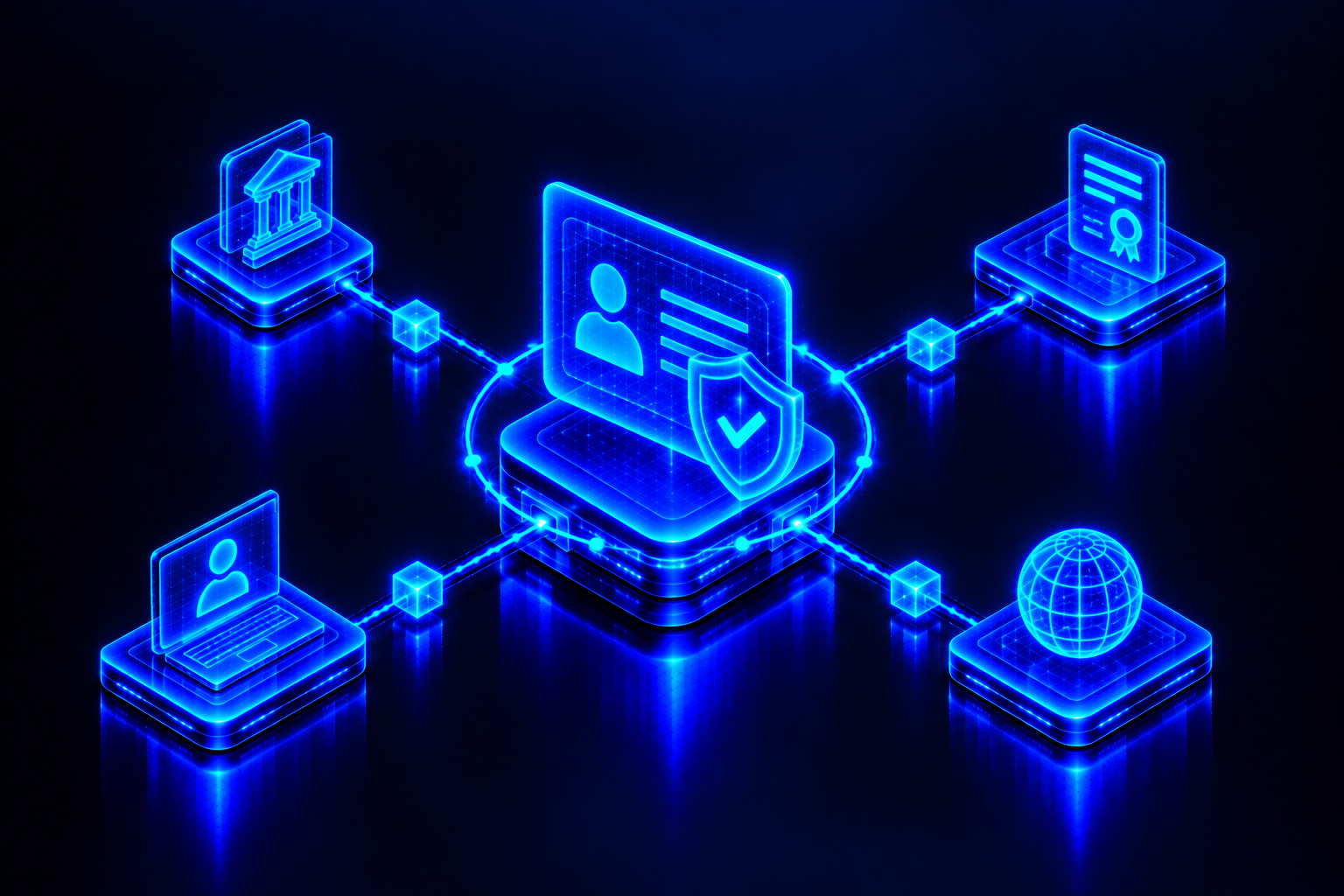
A Zero-Knowledge Identity system generally consists of four components:
Credential Issuer
A trusted organization issues a digitally verifiable credential.
Identity Wallet
Users securely store their credentials in a decentralized wallet.
Zero-Knowledge Proof Generator
The wallet creates cryptographic proofs for specific claims without exposing underlying data.
Verifier
Applications verify the proof without accessing the original personal information.
Together, these components establish trust while preserving privacy.
Use Cases
Age Verification
Users prove they meet age requirements without revealing their date of birth.
Financial Services
Institutions perform compliance checks while collecting minimal customer data.
Healthcare
Patients verify medical eligibility without exposing complete health records.
Enterprise Access
Employees prove authorization levels without revealing unnecessary personal information.
Challenges
Despite its enormous promise, Zero-Knowledge Identity still faces several challenges:
- Wallet usability
- Standardization across ecosystems
- Computational complexity
- Regulatory adoption
- Interoperability between identity providers
As zero-knowledge technologies mature, these barriers are expected to diminish.
The Future of Privacy
For decades, digital identity has required users to trade privacy for convenience.
Zero-Knowledge Identity offers a fundamentally different model—one where trust is established through mathematics instead of unnecessary data disclosure.
As decentralized identity and zero-knowledge cryptography continue to evolve, future online interactions may require far less personal information while providing even stronger security.
The future is private:
the best way to protect personal information isn’t to share it more securely—it’s to avoid sharing it whenever possible.

Leave a Reply