
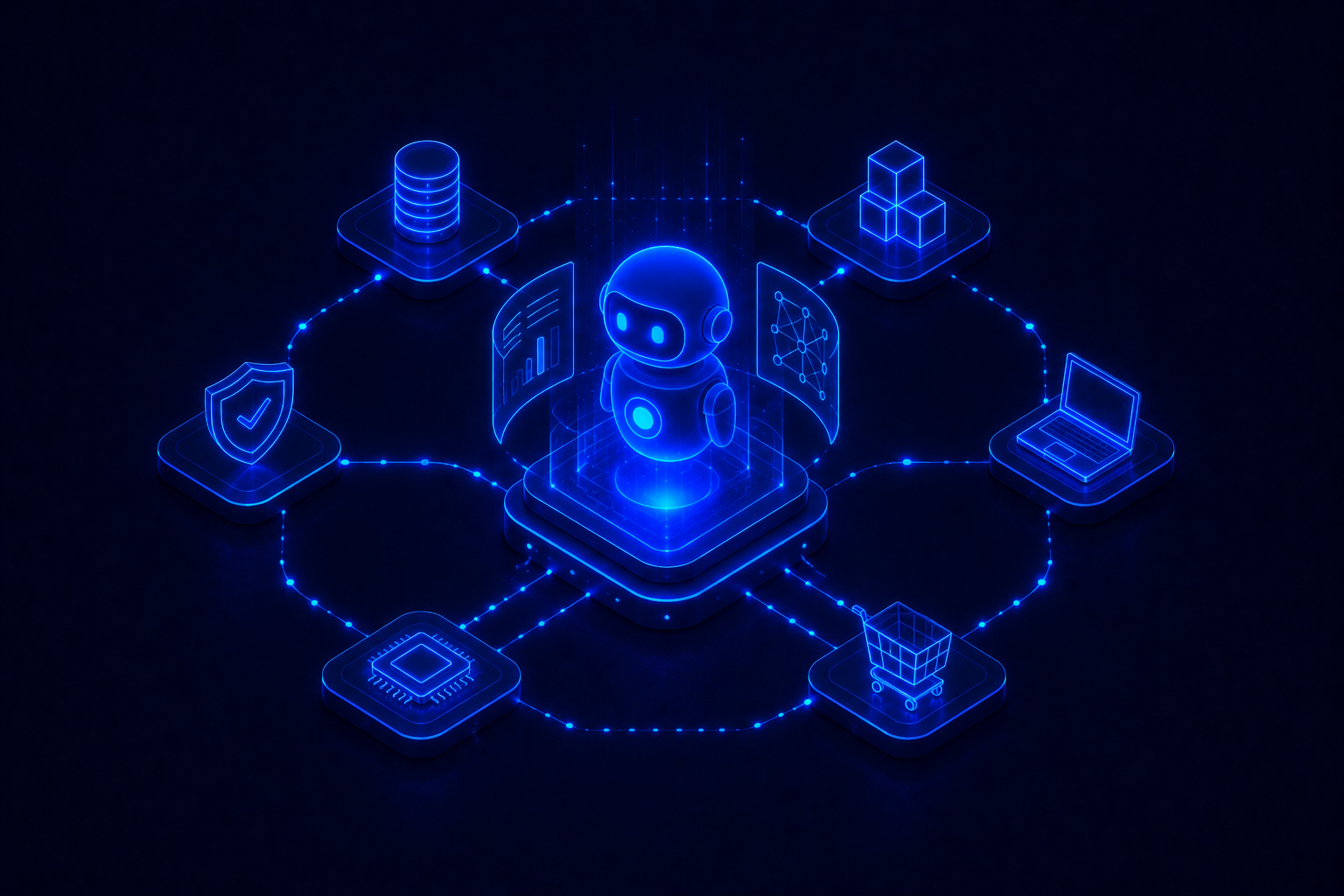
Artificial Intelligence and blockchain are two of the most transformative technologies of our time. Individually, they are reshaping industries. Together, they are creating an entirely new category of digital systems: AI Agents on Blockchain.
These agents are capable of making decisions, executing transactions, interacting with protocols, and coordinating with other agents — all without continuous human intervention.
The result is a future where software doesn’t just follow instructions; it actively participates in digital economies.
What Are Blockchain AI Agents?
A blockchain AI agent is an autonomous software entity that combines:
- Artificial intelligence for decision-making
- Blockchain for execution and ownership
- Smart contracts for automation
Unlike traditional bots, AI agents can analyze information, adapt to changing conditions, and perform actions directly on decentralized networks.
Why It Matters
Autonomous Decision-Making
Agents can evaluate situations and act independently based on predefined objectives.
24/7 Operation
Unlike humans, agents can continuously monitor markets, protocols, and opportunities.
Trustless Execution
Actions are recorded and executed transparently through blockchain infrastructure.
Scalable Coordination
Thousands of agents can interact simultaneously without centralized control.
How It Works
AI agents typically rely on several layers:
Intelligence Layer
Processes information and generates decisions.
Wallet Layer
Allows agents to own assets and interact with networks.
Smart Contract Layer
Executes actions automatically.
Data Layer
Provides access to on-chain and external information.
Together, these layers enable agents to function as independent economic actors.
Use Cases
DeFi Portfolio Management
Agents optimize investment strategies automatically.
Trading and Market Making
React to market conditions in real time.
Supply Chain Coordination
Manage logistics and resource allocation autonomously.
Decentralized Services
Agents provide digital services and receive payments directly.
Challenges
The rise of autonomous agents introduces important considerations:
- Security of agent-controlled assets
- Reliability of AI decision-making
- Governance and accountability
- Coordination between agents and humans
Managing these risks will be critical as adoption grows.
The Future of Autonomous Economies
Blockchain provides ownership and execution. AI provides intelligence and adaptability. Together, they create systems capable of operating with minimal human involvement.
As infrastructure matures, AI agents may become one of the most active participants in decentralized ecosystems — negotiating, transacting, and collaborating at machine speed.
The future is autonomous:
digital economies won’t just be used by humans — they will be populated by intelligent agents acting alongside them.



Leave a Reply